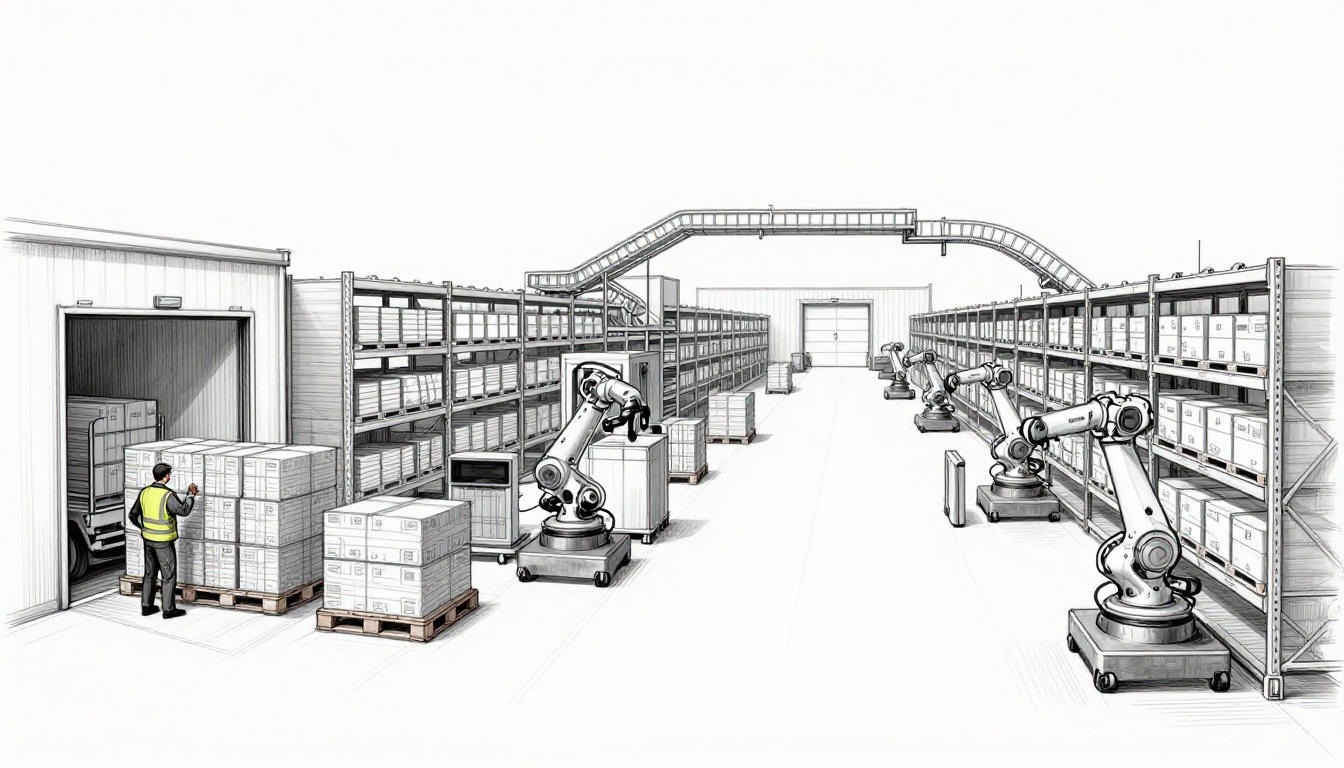
At dawn, trucks nose up to dock doors, and the whole place starts humming. Inside, robots whir past towering shelves, while workers move with purpose and purpose means speed.
A distribution center can feel like one giant machine, but it’s really a chain of small steps. Each step decides whether your order arrives on time or shows up late. In 2026, automation and AI help more facilities do that chain work faster and with fewer mistakes.
Think about your last online order. First, it gets unloaded and checked. Then it gets stored in a smart location. After that, it gets picked, packed, sorted, and sent to a carrier. When you understand what happens in a distribution center, you also understand why some operations ship so fast.
The scale is huge too. The global warehouse automation market is around $30 billion in March 2026, and it keeps growing because e-commerce keeps demanding more.
How Goods First Enter: The Receiving Process
Receiving is where distribution centers “reset reality.” Inbound shipments arrive with labels, pallet counts, and expected contents. The job is to confirm what’s actually there before it causes trouble later.
Trucks pull in, and dock doors open in a steady rhythm. At each bay, cameras and scanners check barcodes and often look for damage. If a pallet looks wrong, the system can flag it right away. That matters because a single bad pallet can slow everything downstream.
Then comes the fast move into the building. Many centers use high-speed conveyors or automated pallet systems to move freight off the truck and deeper into the facility. Instead of waiting for someone to carry each pallet, the equipment keeps pallets flowing at a consistent pace.
Meanwhile, staff do hands-on checks, but they do them with help. Wearable scanners and handheld mobile devices capture counts and verify labels. In some setups, workers also use voice prompts, so they can keep both hands free during quick inspections.
Because receiving sets the tone, the technology focuses on accuracy first. It’s not exciting work, but it’s the foundation for fewer rework cycles later.
If you want a closer look at what “automated receiving” means in practice, see Automated Receiving Systems from Dematic. The core idea is simple: verify and route inventory immediately, so the rest of the building doesn’t guess.
Unloading with Tech Precision
Inside the dock area, the process looks almost choreographed. Pallets roll in, sensors scan, and the system captures key details. Vision systems can spot damage that’s hard to notice during quick manual checks.
After scans confirm what arrived, pallet movement gets scheduled. Some centers push pallets onto automated storage lines quickly, while others stage them briefly before put-away. Either way, the goal stays the same: reduce waiting time.
Also, paper lists are becoming less common. Many centers use mobiles or station scanners instead. That reduces typing errors and speeds up the exchange of “what arrived” data with the warehouse management system (WMS).
AI Checks for Accuracy
Once the shipment is scanned, the checks get smarter. AI systems and rules-based software compare what came in against what was expected. For example, they can flag mismatched quantities or unusual SKU patterns.
If something looks off, the facility doesn’t ignore it. It routes the pallet to an exception lane for review. That lane might include an associate with a mobile device, or a team member who verifies paperwork and re-labels when needed.
In other words, the system doesn’t aim for perfection by itself. Instead, it aims for early detection. Fixing a problem at receiving often takes minutes. Finding it after the item gets stored or picked can take hours.
That’s why the receiving step can feel like a checkpoint at the start of a race. After it clears, everything else speeds up.
Storing Items the Smart Way
Storage is where the distribution center builds speed for later. But it can’t just “put things on shelves.” It has to place items so picking stays fast and robots move efficiently.
Most centers use automated storage and retrieval systems, meaning pallets or totes travel through a managed network of racks, shuttles, and cranes. AI and software decide where each item goes. Then tracking systems keep the WMS updated so pickers always know where to find products.
Also, storage decisions aren’t random. Many systems consider demand patterns. If an item sells every day, it usually shouldn’t be buried deep. Instead, it gets closer to the picking area.
At the same time, distribution centers still operate under real-world constraints. They deal with mixed SKUs, changing seasonal demand, and inbound surprises. So software updates storage plans continuously.
Some sites even use digital models of their warehouse layout to test “where things should go.” The result is less walking, fewer robot detours, and smoother replenishment.
Workers still play a role here. They may oversee replenishment, handle special cases, and scan items that need confirmation. But with WMS guidance, they spend less time searching.
Automated Racks and Shuttles
Automated storage often relies on equipment that moves goods without constant human travel. High-density systems can store more inventory in the same footprint. They also reduce the time it takes to retrieve items.
For a good overview of ASRS (Automated Storage and Retrieval Systems), check ASRS solutions from Element Logic. These systems pair intelligent storage with software control so retrieval stays fast, even when SKUs change.
When storage works well, it creates a simple effect: picking becomes predictable.
Placing Goods Where They’re Needed Most
Now imagine the distribution center like a kitchen. The “hot” ingredients need to be near the cook. The “rare” items can live farther away.
AI models help place popular items closer to the pick face. For example, the system can shift placement when demand rises or when promotions start. It may also adjust where buffer inventory sits to prevent stockouts during peak hours.
Most importantly, the WMS tracks every move. That tracking creates trust. Pickers and robots don’t guess. They follow live directions.
So even though storage looks quiet compared to receiving, it’s doing a lot of work behind the scenes.
Picking Orders: Robots and People Team Up
If receiving is the start, picking is the heartbeat. This is where the distribution center turns stored inventory into real orders.
In many modern sites, picking runs in waves or batches. The WMS groups orders by location, so robots and people travel less. Then it assigns pick tasks based on the fastest path through the warehouse.
Robots handle repetitive motions. For example, goods-to-person systems can bring bins or totes to pickers. Other robots pick items from shelves using vision and grippers. These systems don’t just “grab and hope.” They use sensors to confirm item presence, position, and sometimes item type.
Meanwhile, people handle the final responsibility. They confirm quality, manage exceptions, and keep tasks moving when something is damaged or unclear.
The best setups feel like teamwork. Robots handle motion and consistency. Workers handle judgment and problem-solving.
As a side note, even when robotics reduces labor needs, it doesn’t eliminate workers. Most centers still rely on supervisors, quality checks, and exception resolution.
If you want an example of a robots-to-goods approach, see Robots-to-Goods automation with Locus. The focus is on bringing robots to inventory locations to stabilize fulfillment as demand shifts.
Robots Grabbing the Right Stuff
Robot picking starts with a map. The WMS tells the system where each item sits. Then sensors confirm the exact location and condition.
Grippers and end-of-arm tooling handle different package types. A carton might need one tool. A bag or poly-wrapped item might need another. AI vision helps verify the item before the robot commits.
This matters because picking errors can create the worst kind of delay. A wrong item in a packed order often leads to returns, rework, and customer support headaches.
Robots also work around the clock. While humans take breaks, automated systems can keep tasks consistent if the facility has enough staffing to handle exceptions.
Pickers Focusing on Quality
Humans still play a key role. When a robot or system flags a potential mismatch, a picker verifies quickly using a mobile scanner or guided steps.
Often, pickers focus on three things:
- Matching the right SKU to the order
- Checking packaging condition (seal, damage, label)
- Handling exceptions like substitutions or mis-shelves
Some facilities use batch picking, where multiple orders move through the same workflow. Workers then separate items into order-specific containers. That keeps throughput high while still leaving room for human accuracy checks.
In other words, the shift is real. Many sites move from “picking everything manually” to “supervising and validating more work.”
Sorting, Packing, and Shipping Out Fast
Once the right items are picked, the distribution center turns into a sort-and-ship factory. Now speed matters in a different way.
First, items go to packing stations. Before packing, many systems route items through sortation equipment that directs each piece to the correct lane.
High-throughput sorters can handle different item sizes. Some use tilt trays. Others use diverters, chutes, or rotating gates. AI or rule-based logic chooses the route based on order requirements.
Then packing gets optimized. Some benches use sensors for auto-dimensioning. That can reduce manual measuring and help pick the right box size. In addition, visual checks can confirm labels, barcodes, and shipment details before the order leaves the building.
After packing, shipping workflows kick in. The system routes shipments to outbound docks. It can also plan truck schedules based on carrier pickup times.
In many centers, automation helps reduce downtime. If a sort line runs smoothly, workers can keep packing steadily. That stability helps the center hit cut-off times for next-day delivery.
In a busy operation, it can look like a controlled storm. Items flow in, lanes sort them out, and boxes disappear toward the dock.
Sorters Speeding Things Along
Sorting equipment is built to move small objects fast. It’s like a traffic system for packages. If routing stays accurate, packed orders reach the right truck without delay.
Automation also helps prevent jams. Sensors can detect blockages, misroutes, or unusual package shapes. Then the system can pause a lane, reroute items, or alert a technician.
For more on warehouse sorting systems, take a look at OPEX Sure Sort automated sorting. Systems like this aim to improve throughput and reduce manual sorting during peaks.
Packing with Auto-Checks
Packing is often where accuracy meets customer experience. A bad label or wrong weight can cause delivery failures. So many stations use checks that catch errors quickly.
Auto-dimensioning helps choose box sizes. Scales confirm weights. Cameras can verify label placement. Dashboards track station status, so managers can see bottlenecks early.
Because packing depends on speed, auto-checks reduce the time between “item arrives” and “order ships.” That keeps the outbound flow steady.
Also, automation can reduce repeat work. If the system can catch the error earlier, workers don’t have to undo as much later.
Final Push to Trucks
Outbound routing brings everything together. After packing, shipments move through final sort steps. Then they stage at outbound docks in scheduled groupings.
AI can support routing decisions, especially when truck arrival times and carrier constraints vary. Even without advanced AI, software planning still matters because it prevents chaos.
Many facilities also run 24/7 operations. Automation can make that possible with fewer breaks in the workflow. Still, staff coverage remains essential for exceptions, maintenance, and quality control.
In practice, the center aims for one simple outcome: get the right box to the right truck, on time.
What Workers Do Now and Staying Safe
Inside a modern distribution center, workers don’t just “pick.” They supervise, verify, and fix. That shift changes the daily rhythm.
A key trend is that automation handles more repetitive steps than it used to. But it’s not everywhere. Recent estimates suggest 80% of warehouses lack any automation. That means many facilities still run mostly manual work, or they use automation only in pockets.
Still, where automation exists, workers often focus on the parts that need a human brain: resolving exceptions, performing spot checks, and supporting the equipment.
Safety also becomes a bigger focus. Robots and conveyors move fast. So centers use sensors, safety zones, and systems that slow or stop equipment when needed.
Software can also predict hazards. For example, if a safety sensor repeatedly triggers at one point, the facility can adjust traffic flow or equipment settings.
Meanwhile, wearable tech can improve safety and quality. Devices may track location, prompt tasks, and support quick communication during busy periods.
From Pickers to Supervisors
The role evolution is one of the biggest changes in recent years. Instead of only picking, many associates manage robot flows and validate tasks.
Mobile devices guide them step-by-step. Voice prompts can reduce the need to look down at screens. As a result, workers spend more time watching the process and less time searching for information.
At the same time, centers need training. Workers learn new workflows, new exception rules, and basic troubleshooting. It’s a different job than it was ten years ago, even when the building looks familiar.
And labor shortages make this shift more urgent. Companies can’t always add enough people for peak seasons. So they invest in automation and training to keep output steady.
Tech Keeping Everyone Safe
Safety technology isn’t just “extra.” It’s part of daily operations.
Common safety features include:
- Safety scanners and light curtains around robot zones
- Auto-shutdown triggers for unsafe conveyor conditions
- Tracked locations so people and robots don’t conflict
- Wearable alerts to guide safe movement routes
- Camera-based incident reporting for faster follow-up
Robots usually stop near people because safety systems monitor distance. However, equipment still needs human oversight. That means workers help keep the environment clear, maintain lanes, and handle blocked equipment safely.
Also, because sites get busier, good safety habits matter more. Clear floor markings, correct lift techniques, and consistent training reduce risk.
If you remember one thing from this section, remember this: safety improves when tech and people work together.
Automation can reduce the number of risky steps, but it still needs smart humans to supervise.
Conclusion: The Dock Is Just the Beginning
Inside a distribution center, every step connects to the next. Receiving checks what arrived, storage places it for fast access, picking turns inventory into orders, and sorting sends packages to trucks.
The big takeaway is simple: automation and AI reduce guesswork, especially when the center runs at high volume. That’s why automation can support higher order accuracy and faster fulfillment, while workers focus on quality and exceptions.
If you’ve ever wondered why your order shows up so quickly, now you know where the speed comes from. With the warehouse automation market around $30 billion in March 2026, expect more centers to build this kind of workflow.
Want to learn more about what’s happening near you? Check for distribution center updates in your area, and pay attention to how local facilities describe their receiving, robotics, and safety upgrades.